
Every new technology comes with its upside. But for every upside, there’s also the potential for people to use it for criminal purposes. AI is no different. The ability to generate fake images allows crypto scammers to appear real and trustworthy.
At a glance, these profiles seem real. Built on an AI-generated image, the scammer builds out a profile - Instagram, X, LinkedIn. They post about trading wins or a luxury lifestyle. Then they reach out to people, gradually building a following on a fake platform. That’s just one potential scam.
But if they’ve got fake images, fake profiles, and a legit-looking platform, how can you tell a real person from a fake one? That’s where social media image search and reverse lookup tools can help.
Why Crypto Scams Are Using AI-Generated Faces
Trust is the biggest factor in business.
When someone contacts you about a potential opportunity, where do you go? You can’t talk to their friends or past business partners. Rather, you check out their LinkedIn profile or review their X posts.
Using an AI-generated face, crypto scammers can add a face to their account, giving it the air of authenticity. The face doesn’t fall into the same trap as stealing other people’s social media photos. There’s no risk of reverse image detection or identity tracing.
That’s perfect for fake investors, a romance/crypto hybrid scam, or Telegram/Discord communities. If the pitch starts on a dating app, check the dating profile picture before the conversation turns to money.
What Are AI-Generated Faces?
AI-generated faces are synthetic images created by machine learning models trained on vast datasets of real human faces. Instead of editing an existing photo, the system builds a completely new face from scratch - one that doesn’t belong to any real person.
Early versions were easy to spot, often distorted or unnatural. But newer models are far more convincing, producing faces that look entirely believable at a glance. That said, subtle inconsistencies can still appear.
Social media facial recognition can indirectly help flag these profiles. While an AI-generated face won’t match a real person, the absence of any consistent presence across platforms can reveal that the identity itself isn’t genuine.
Why AI Faces Are Harder to Detect
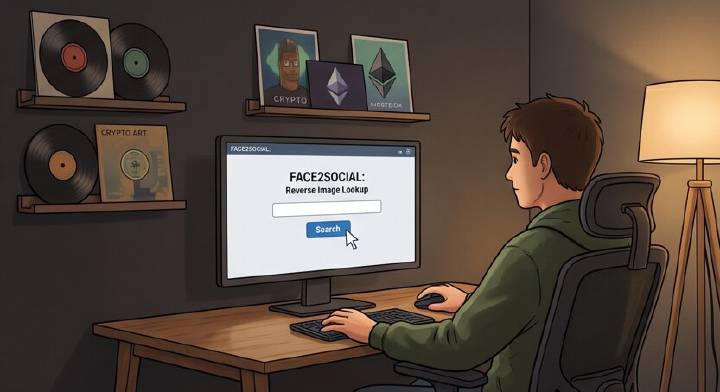
Reverse image lookup for detecting fake crypto profiles.
AI faces aren’t based on a source image. They’re an amalgamation of thousands of faces - not a copy of any single real person. That’s a problem. It makes it much harder to track.
Depending on the crypto scam, a social media reverse lookup can yield either no profiles at all or a highly curated, believable profile. As newer models become more realistic, it can be harder to tell a fake profile from a real one.
Standard reverse image searches (like Google’s) won’t return any results. The image isn’t a copy of any existing images, so it can’t be traced by this method. A face-based X face search can still surface the scam profile itself, since it matches the face rather than copies of the file.
How Social Media Image Search Helps Expose Fake Profiles
Social media image search isn’t a foolproof method to uncover crypto scammers. But it’s still one of the most useful tools in your arsenal.
If you submit the fake photo to the image searcher, you’ll get one of three results:
- No profiles. This is highly suspicious. Anyone in the crypto space is likely to have a social media presence. No accounts across LinkedIn, Instagram, Facebook, or X is a red flag.
- A single set of profiles. A good scammer will use a single persona across several social media accounts. Often, there’s a history of weeks or months of postings. What you’re looking for is non-perfect photos or evidence of posting from 5 or more years ago. AI isn’t good at creating images that don’t look pristine.
- Several profiles use the same fake image. The hallmark of a sloppy scammer. If the same AI image is used for multiple profiles, it’s a clear sign of a scam.
Combine this image search with behavioral checks, and you’ve got a reasonably accurate system for detecting scammers.
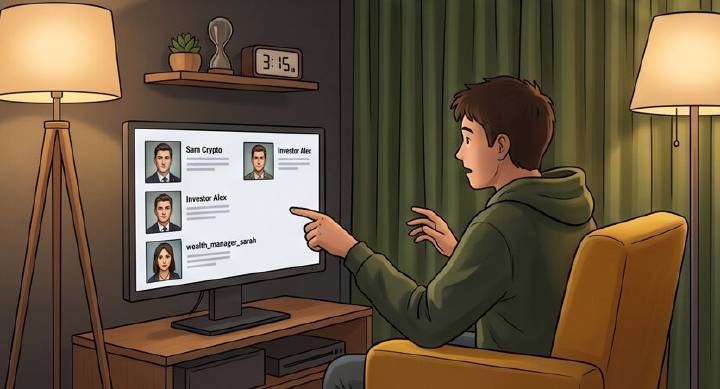
Multiple fake profiles using the same AI generated face.
Step-by-Step: How to Check a Suspicious Profile
So how do you actually check whether a profile is real?
Step 1. Save the Profile Image
Download the profile image using the cleanest available version. Ideally, you’d use a forward-facing image with good lighting.
Step 2. Run a Social Media Reverse Lookup
Upload the image to Face2Social and set it to search. After around 30 seconds, you should find results from Facebook, Instagram, X, and TikTok. Add in a Google reverse image search to further expand your findings.
Step 3. Analyze the Results
Evaluate your results based on three scenarios listed above: (1) no findings = suspicious, (2) a single set of profiles - check for a long history of posting or images that are unlikely to be AI, (3) multiple different profiles using the same image - highly likely to be a scam.
Step 4. Cross-Check the Profile
Now, you’ll want to perform a quick behavioral search. Based on the profiles you receive from the search, look through their posts, review their follows and interactions, and see how deep their identity goes.
Most people in the crypto world are online a lot. And so, there is depth in their interactions and digital footprint. The same is less likely to be true of fake personas.

Verify online identity by checking deep digital footprint history.
Visual Clues an Image May Be AI-Generated
AI-generated photos get better every day. Even with a social media image search, you’ll still want to evaluate the photos for any discrepancies. Look for:
- Subtle asymmetry in eyes or ears
- Distorted backgrounds
- Odd lighting or blurred edges
- Accessories (glasses, earrings) look warped
AI-generated faces are getting harder to spot - but that doesn’t mean you’re powerless. With a quick social media image search, you can uncover inconsistencies, track profile history, and make smarter decisions before you engage.
Face2Social helps you verify identities across major platforms in seconds. Run a search, check the trail, and protect yourself before you trust, message, or invest.
Frequently Asked Questions
Why do crypto scammers use AI-generated faces instead of stolen photos?
A stolen photo can be traced back to its real owner with a reverse image search, but an AI-generated face belongs to no real person. That gives scammers a face that adds an air of authenticity with no risk of reverse image detection or identity tracing. It suits fake investors, romance and crypto hybrid scams, and Telegram or Discord communities.
Can Google reverse image search detect an AI-generated face?
No. An AI-generated face is not a copy of any existing image, so a standard reverse image search like Google’s won’t return any results for it. A face-based social media search can still surface the scam profile itself, because it matches the face rather than copies of the file.
How can you tell if a profile picture is AI-generated?
Look closely for subtle asymmetry in the eyes or ears, distorted backgrounds, odd lighting or blurred edges, and accessories such as glasses or earrings that look warped. Newer AI models are far more convincing than early versions, so combine that visual check with a social media image search and a look at the profile’s posting history.
What does it mean if a face search finds no social media profiles?
In the crypto space, that is highly suspicious. Anyone active there is likely to have a social media presence, so no accounts across LinkedIn, Instagram, Facebook, or X is a red flag. If the search instead finds several different profiles using the same image, that is a clear sign of a scam.